


In the previous post,
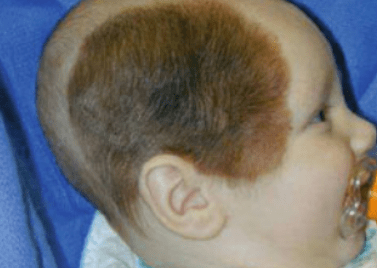
I presented a case of an infant with a congenital nevus, and through research, demonstrated an interesting fact:
When a certain level of mechanical stretch is applied to the skin, the human body creates new skin to adapt to this tension.
So, what happened to the baby whose face had swollen like a balloon
after the surgery?

To treat a baby with a mole of this size,

they used a tissue expander to gradually stretch the skin in this way.

After the surgery, the results were this clean.
Even after the excision, we were able to stretch the skin with some remaining capacity.
So, what can we learn from this?
Among the three tissue expanders used for the baby,
the area corresponding to the right cheek almost exactly matches the surgical range of a facelift.

Conversely, this means that even a baby’s firm, elastic skin, when subjected to pulling force (tension)

initially stretches and expands like a rubber band.

If this pulling force exceeds a certain level, the skin actually begins to produce new tissue (the pink ovals, skin cells).
In other words, with a pulling method andapng tension—there is no real benefit to pulling the front of the face.
At first, the tension (pulling force) is transmitted to the front of the face,
so nasolabial folds and wrinkles around the mouth may appear lifted.
However, over time, new skin forms in the areas under tension
and the tissue expands.
As a result, the sagging eventually recurs.
The stronger the pulling force, the more this effect is amplified.
That is why, in facelift procedures, excessive pulling should be avoided.
Easy things don’t really exist, do they?
So, what should be done?
To avoid pulling the skin, you first need to reach the areas where the skin has sagged and there is enough looseness. (With a precise understanding of the anatomical structure, carefully avoiding and preserving critical areas.)
Then, after accessing those areas, you reduce the excess, leaving only as much as needed.

When wearing rubber gloves, if a woman puts on gloves made for men,
there will be excess material wrinkling here and there.
Even the fingertips won’t be fully filled, leaving the glove loose and crumpled.

Then, even if you trim off the overly long finger parts to make the gloves fit a woman, the gloves won’t stretch out again.
You could adjust them to fit perfectly for a woman.

However, if a woman forcefully pulls and stretches men’s rubber gloves to make them fit, she might be able to push her fingers all the way in at first,
but with use, the gloves will become wrinkled again.
Or, if the wrist area is pulled too much, it may stretch out or even tear.
In the end, a facelift procedure is not about pulling,
but more accurately, about reducing excess tissue.
In the Western countries where this surgery was first developed, there are two terms used to refer to a facelift.
The first is facelift,
which is closer in meaning to “lifting (up) or pulling the face.”
The second is rhytidectomy,
which means “removing or excising wrinkles.”
These days, the term “facelift” is used more often because it’s more intuitive and easier to understand.
On the other hand, “rhytidectomy,” which means reducing or excising wrinkles, tends to feel a bit outdated and was used more commonly in the past.
Personally, from a principled standpoint, I see it as a procedure that reduces the volume associated with wrinkles.
Simply pulling doesn’t produce effective results.
So rather than a lifting procedure, it’s closer in concept to soft tissue contouring—essentially, a form of soft contouring.
That’s why I prefer the term “rhytidectomy.”
But then again… who actually cares about what that means?
My writing might be similar in that way.
Who would even be curious about this? (lol)
Next time, I’ll come back with something a bit more interesting and lighter.
If anyone has taken the time to read this, I sincerely thank you, and if you have any questions, please feel free to leave a comment even if it takes some time, I’ll make sure to respond.